Test Maintenance and Self-Healing in CI/CD
Overview
Test maintenance is one of the largest hidden costs in test automation. Automated tests are valuable only when teams trust them, but trust disappears when tests fail for reasons unrelated to product quality: renamed buttons, changed locators, slow environments, stale test data, broken fixtures, expired credentials, or brittle waits.
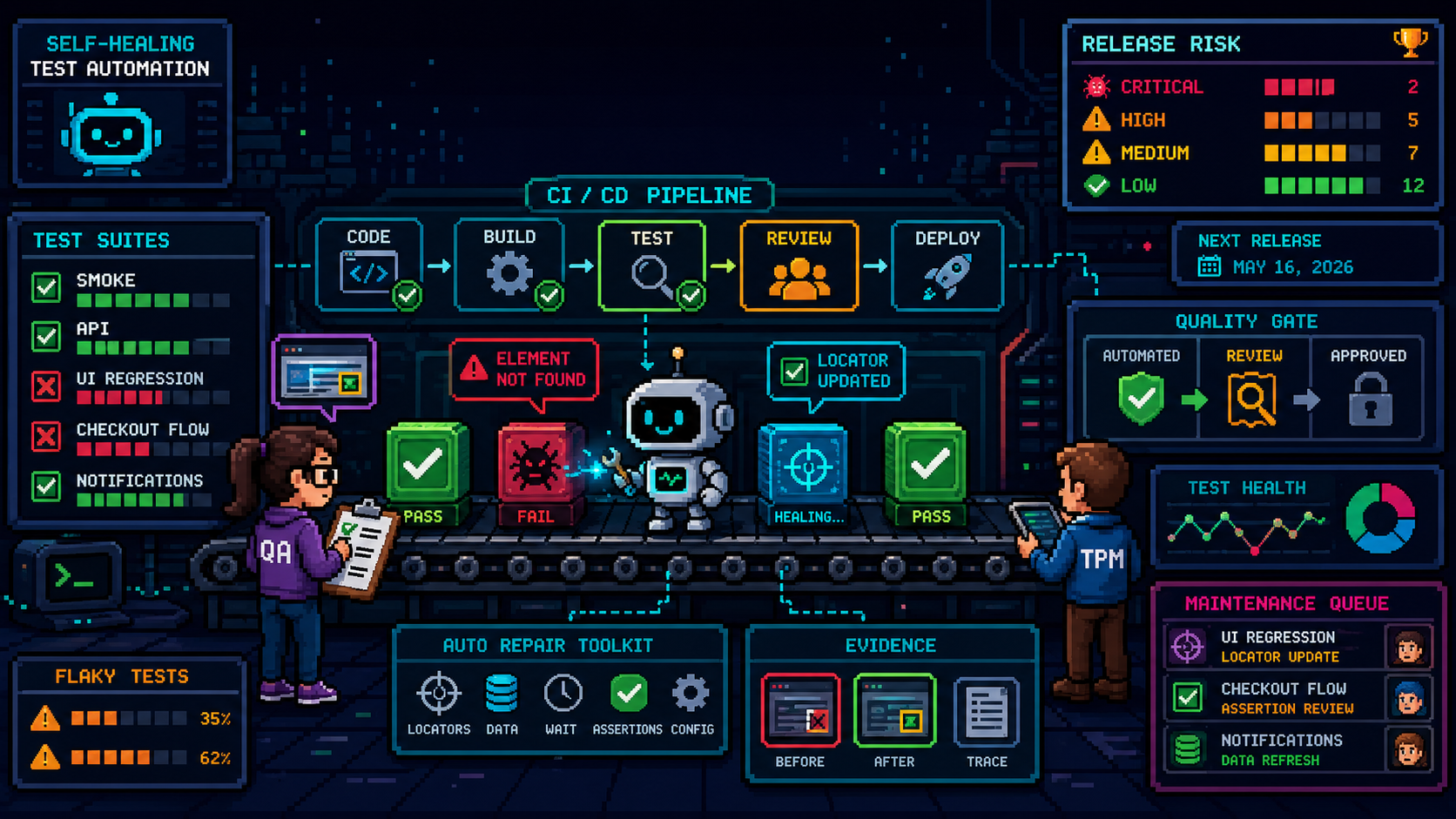
Self-healing test automation tries to reduce that maintenance cost. A self-healing system detects why a test failed, proposes or applies a low-risk repair, verifies that the test still checks the same user behavior, and records the change for review. In a CI/CD pipeline, this can turn noisy failures into structured maintenance work instead of forcing QA engineers to manually inspect every broken test from scratch.
The important rule is simple: self-healing should preserve test intent, not hide product defects. A system may safely update a locator when a button is renamed from Submit to Save, but it must not silently skip a missing checkout step or loosen an assertion until a broken feature appears healthy. QA and TPM involvement is required wherever the test meaning, release risk, ownership, or timeline changes.
The Problem
Automated test suites age quickly. Product teams change UI layouts, APIs evolve, data models shift, dependencies update, environments slow down, and CI infrastructure behaves differently from local machines. Even strong tests require routine care.
Common maintenance problems include:
- UI locators breaking after layout or copy changes.
- Test data becoming invalid after backend rule changes.
- API contracts changing without corresponding test updates.
- Flaky timing caused by async loading, animations, retries, or network delay.
- Shared state between tests.
- Expired credentials, tokens, or seeded accounts.
- Tests that assert implementation details instead of user-visible outcomes.
- Large regression suites that are too slow to diagnose manually.
Without a maintenance strategy, teams often respond in unhealthy ways: they add broad retries, skip failing tests, lower assertion quality, or stop trusting CI. Self-healing can help, but only if it is designed as a controlled maintenance workflow.
What Self-Healing Should Mean
Good self-healing can:
- Detect that a locator changed and find a stable replacement.
- Recommend a better selector based on role, label, accessible name, or test ID.
- Rebuild stale test data from approved fixtures.
- Re-run a failure once when infrastructure instability is likely.
- Group failures with the same root cause.
- Create a pull request with a proposed test update.
- Attach screenshots, traces, logs, DOM snapshots, and before/after evidence.
- Route the issue to the correct owner.
Bad self-healing can:
- Skip a failing assertion.
- Replace a missing user action with a different action.
- Add arbitrary waits instead of fixing synchronization.
- Accept new behavior without product confirmation.
- Change application code to make a test pass.
- Hide a release-blocking defect behind retries.
The goal is not automatic forgiveness. The goal is automatic diagnosis, safe repair, and clear escalation.
How It Fits Into CI/CD
Your attention is a comadity. You don’t jump form your tasks to see why pipline is red again you getting notify only when it’s not been automated. Self-healing works best when it is treated as a pipeline capability, not a separate tool that runs after everyone has lost confidence in the suite.
1. Pull Request Stage
The pull request stage should stay fast and conservative. It should protect developers from obvious regressions without introducing risky automatic changes.
Recommended automation:
- Run the smallest relevant test set based on changed files, tags, ownership, and recent failures.
- Capture rich failure artifacts: screenshots, traces, logs, videos, network records, console errors, API responses, and test metadata.
- Classify each failure as likely product bug, test bug, environment issue, data issue, or unknown.
- Suggest locator or fixture fixes when confidence is high.
- Comment on the pull request with the diagnosis and proposed next action.
What should not happen automatically:
- Do not merge self-healed test changes without review.
- Do not skip failing tests to unblock the PR.
- Do not relax assertions during the PR run.
- Do not change production code from a test-healing job.
Best outcome: the PR author sees a clear failure summary and, when appropriate, a generated patch for the test owner to review.
2. Main Branch Stage
The main branch stage should confirm that merged changes are stable across a broader suite. Self-healing can be more active here, but still controlled.
Recommended automation:
- Run critical smoke, contract, API, integration, and end-to-end tests.
- Compare failures against historical flake patterns.
- Open a maintenance ticket or pull request for likely test-only issues.
- Mark repeated infrastructure failures separately from product failures.
- Notify QA owners when a test’s intent may have changed.
- Notify TPMs when failures affect release scope, timeline, or cross-team dependencies.
Best outcome: main branch failures are triaged quickly and routed to the right person instead of becoming general CI noise.
3. Nightly or Scheduled Regression Stage
Nightly regression is where deeper maintenance automation becomes most useful. The suite can run longer, collect richer evidence, and attempt more repairs.
Recommended automation:
- Run full regression suites across browsers, devices, locales, permissions, and data states.
- Detect flaky tests through repeated execution and historical failure rates.
- Generate self-healing pull requests for locator updates, fixture repairs, or tagging changes.
- Produce a QA review queue ranked by release risk.
- Produce a TPM release-risk summary with impacted features, owners, and aging failures.
Best outcome: the team starts each day with a prioritized maintenance list rather than a wall of unrelated red builds.
4. Release Candidate Stage
Release candidate pipelines should prioritize confidence over automatic repair. At this point, self-healing should mainly provide diagnosis and escalation.
Recommended automation:
- Run critical path tests and release-blocking checks.
- Attach failure evidence to release dashboards.
- Block release when critical journeys fail.
- Escalate unresolved high-risk failures to QA, engineering, product, and TPM owners.
- Require human approval before accepting any self-healed test change.
Best outcome: the release process knows whether the product is safe to ship, not merely whether the tests can be made green.
A Practical Self-Healing Pipeline
A mature CI/CD flow can look like this:
- A test fails in CI.
- The pipeline captures artifacts: screenshot, trace, logs, DOM, network data, test metadata, commit hash, environment, browser, device, and linked requirement.
- A classifier assigns a likely cause: product bug, locator change, test data issue, environment issue, flaky timing, dependency outage, or unknown.
- The healing engine proposes a repair only for approved categories.
- The repaired test runs in isolation.
- The repaired test runs again with related tests to catch side effects.
- The system compares the repaired test against the original intent: name, tags, linked requirement, user journey, assertions, and screenshots.
- If the repair is low risk, the system opens a pull request with evidence.
- QA reviews whether the test still validates the correct behavior.
- Developers review code quality and maintainability.
- TPM reviews release impact when failures affect scope, timing, or stakeholder commitments.
- After approval, the fix merges and the pipeline records the maintenance event.
This creates a controlled loop: detect, diagnose, propose, verify, review, merge, and measure.
What Can Be Automated Safely
Some changes are good candidates for automatic proposals because they are mechanical and easy to validate.
Failure Triage
AI and rules-based tools can summarize failures and group them by root cause.
Useful outputs:
- “12 tests failed because the auth fixture returned 500.”
- “5 checkout tests failed after the payment API schema changed.”
- “This failure matches a known flaky test pattern from the last 30 days.”
- “The UI element still exists, but its accessible name changed.”
This is often the highest-value automation because it saves investigation time without changing test behavior.
Flake Detection
The pipeline can track whether a test fails intermittently across commits, environments, browsers, or time windows.
Safer automation:
- Label likely flaky tests.
- Open a ticket with failure history.
- Quarantine a test only with policy-based approval.
- Keep critical tests visible even if flaky.
Risky automation:
- Auto-quarantining critical user journeys.
- Adding retries until the failure disappears.
- Ignoring intermittent failures without root-cause ownership.
QA owns the decision on whether the test still provides useful signal. TPM gets involved when flaky tests threaten release timelines or when multiple teams need to coordinate fixes.
Where QA Must Be Involved
QA should own the meaning of the test suite. Self-healing can propose changes, but QA must validate whether those changes preserve risk coverage.
QA involvement is required when:
- A self-healed test changes a user flow.
- Expected results or assertions change.
- A critical journey fails or becomes flaky.
- The pipeline suggests quarantining, skipping, or downgrading a test.
- A test has no clear requirement, owner, or risk label.
- The system detects a gap in coverage after product behavior changes.
- A test data repair changes business meaning.
QA should review:
- Does the test still cover the intended risk?
- Is the assertion still meaningful?
- Did the repair preserve user-visible behavior?
- Is this a test issue or a product defect?
- Should the suite add a new test instead of modifying the old one?
- Does the failure reveal a missing requirement or ambiguous acceptance criterion?
QA should also maintain the policy for which tests are eligible for automatic repair. For example, a low-risk visual locator update may be eligible for auto-generated PRs, while payment, identity, privacy, and compliance flows require explicit review.
Where TPM Must Be Involved
TPMs should not review every locator update. Their value is release coordination, risk visibility, dependency management, and ensuring that maintenance work does not disappear into CI noise.
TPM involvement is required when:
- Self-healing failures affect release dates or release scope.
- A critical path is blocked across multiple teams.
- A flaky or broken suite prevents reliable release decisions.
- A test failure has unclear ownership.
- The team is repeatedly deferring maintenance work.
- A system-level dependency, environment, or data issue affects several squads.
- A release dashboard needs a human-readable risk summary.
TPMs should track:
- Which failures are release-blocking.
- Which teams own the fix.
- How long failures have been open.
- Whether self-healing is reducing noise or hiding problems.
- Whether test maintenance debt is growing.
- Whether acceptance criteria need clarification.
The TPM role is not to decide whether a locator is technically correct. The TPM role is to make sure unresolved quality risk is visible, owned, and scheduled.
Decision Matrix
| Situation | Pipeline action | QA role | TPM role |
|---|---|---|---|
| Low-risk locator changed, same element and assertion | Open self-healing PR | Review and approve if intent is preserved | Usually not needed |
| Test data missing in isolated environment | Rebuild fixture or open data repair PR | Confirm scenario still matches requirement | Involve if it blocks release or many teams |
| Critical checkout test fails | Block pipeline and attach evidence | Determine product bug vs test issue | Coordinate release impact and owners |
| Test is flaky for 30 days | Label, report history, create maintenance ticket | Decide fix, quarantine, or rewrite | Track debt and release risk |
| Assertion no longer matches product behavior | Block automatic healing | Confirm expected behavior with product/dev | Involve if scope or acceptance criteria changed |
| Many tests fail from same fixture | Group failures and route to owner | Validate impact on coverage | Coordinate cross-team fix if needed |
| Self-healing would skip a step | Reject healing | Treat as possible product or test design issue | Involve if release confidence is affected |
Guardrails for CI/CD Automation
Self-healing needs guardrails because the easiest way to make CI green is to make tests weaker.
Recommended guardrails:
- Never allow self-healing to remove assertions automatically.
- Never allow self-healing to skip critical tests automatically.
- Never allow self-healing to update production code.
- Require pull requests for test changes.
- Require QA approval for critical journey changes.
- Record before/after evidence for each repair.
- Track every healed test as a maintenance event.
- Keep a history of flaky tests and quarantined tests.
- Require owners for every test suite and test category.
- Link important tests to requirements, risks, or user journeys.
- Use separate policies for smoke, regression, contract, accessibility, performance, and security tests.
Metrics That Matter
Self-healing should be measured by whether it improves quality signal, not by how many failures it hides.
Useful metrics:
- Mean time to diagnose test failures.
- Mean time to repair broken tests.
- Percentage of failures correctly classified.
- Number of self-healing PRs accepted versus rejected.
- Flaky test rate by suite and owner.
- Number of quarantined tests and their age.
- Percentage of critical tests with clear owners.
- Escaped defects connected to weak or healed tests.
- Maintenance time per release.
- Release-blocking failures by root cause.
If the number of healed tests rises while escaped defects also rise, the system is probably hiding risk. If diagnosis time falls and rejected repairs are rare, the system is likely helping.
Conclusion
Self-healing test automation can make CI/CD pipelines more reliable, but only when it is bounded by clear ownership and review. The pipeline should automatically collect evidence, classify failures, propose safe repairs, and route work to the right people. It should not silently weaken tests or convert product defects into green builds.
QA must own test intent, assertions, and risk coverage. Developers should own code quality and maintainable test implementation. TPMs should own visibility, coordination, and release impact when failures cross team boundaries or threaten delivery.
The right goal is not a pipeline that is always green. The right goal is a pipeline that tells the truth quickly, repairs low-risk maintenance issues efficiently, and escalates real product risk before it reaches customers.