Test Agent in the Pipeline: Can It Replace the QA Step?
Overview
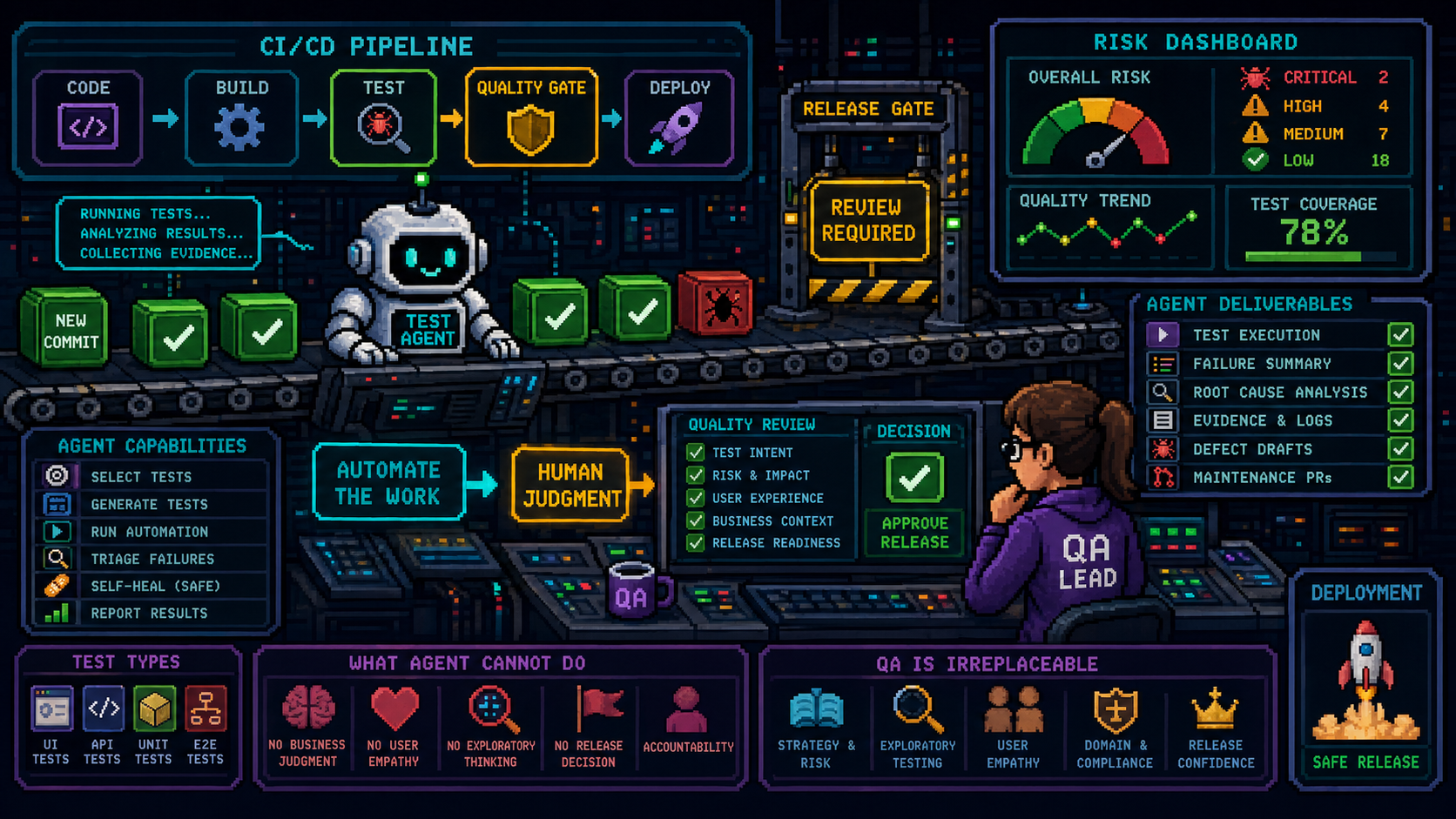
A test agent can sit inside a CI/CD pipeline and perform useful quality work: select tests, generate checks, run automation, summarize failures, inspect logs, open bugs, propose fixes, and report release risk. For many teams, this will become a normal part of software delivery.
But a company should not treat a test agent as a full replacement for QA. The agent can accelerate testing work, but it cannot fully own product judgment, business risk, user empathy, regulatory context, exploratory testing, or release confidence. A pipeline agent can answer “what failed?” and sometimes “what should we try next?” It cannot reliably answer “is this product good enough for our users and business?”
The right model is not “replace QA with an agent.” The right model is “put a test agent in the pipeline to remove repetitive work, then keep QA responsible for strategy, risk, coverage, and final interpretation.”
What a Pipeline Test Agent Can Do
A test agent is an AI-assisted system connected to the development workflow. It may have access to source code, test suites, CI results, logs, traces, screenshots, requirements, tickets, and deployment metadata.
In a pipeline, a test agent can:
- Select relevant tests based on code changes.
- Generate draft unit, API, UI, or contract tests.
- Run existing automation.
- Summarize CI failures.
- Group failures by likely root cause.
- Detect flaky tests.
- Suggest locator or fixture repairs.
- Open bug tickets with evidence.
- Create pull requests for low-risk test maintenance.
- Compare test results across builds.
- Produce release-quality summaries.
This can save time because much of QA and development work involves reading evidence, connecting signals, and preparing structured output.
Where a Test Agent Works Well
Fast Regression Feedback
The agent can identify which test suites are most relevant to a change. For example, a billing code change may trigger billing API tests, checkout UI tests, tax calculation tests, and payment contract tests.
This helps teams avoid two weak extremes: running too little and missing defects, or running everything and slowing every pull request.
Failure Triage
Pipeline failures often create noise. The agent can inspect logs, traces, screenshots, and recent commits to classify failures.
Useful classifications include:
- Product bug.
- Test bug.
- Environment issue.
- Data setup problem.
- Flaky timing.
- Dependency outage.
- Unknown and needs human review.
This does not remove the need for human review, but it gives QA and developers a better starting point.
Test Maintenance
The agent can propose low-risk maintenance changes, such as updating a locator, repairing a fixture, or replacing a brittle selector with a role-based locator.
The key word is propose. A test agent should not silently weaken the suite to make CI green.
Evidence Collection
Good testing depends on evidence. A test agent can attach screenshots, traces, logs, HAR files, changed files, commit links, test reports, and affected requirements to a bug or release summary.
This is one of the safest and highest-value jobs for an agent because it improves human decision-making without changing product behavior.
Draft Test Creation
The agent can draft tests from code diffs, stories, API specs, and acceptance criteria.
These drafts are useful, especially when the repository already has strong patterns. But generated tests still need review for test intent, assertion quality, data safety, and maintainability.
Why a Company Might Want to Replace QA
The pressure is understandable. Manual regression is slow. Test maintenance is expensive. CI failures are noisy. Product teams want faster releases. AI tools can produce tests and summaries in seconds.
From a management view, replacing a QA step with a test agent may seem attractive because it promises:
- Lower cost.
- Faster pipelines.
- More automation.
- Fewer handoffs.
- Consistent reports.
- Around-the-clock execution.
Those benefits are real when the agent is used correctly. The mistake is assuming that faster test execution equals complete quality ownership.
Where QA Is Still Irreplaceable
Defining Product Risk
QA decides what can go wrong and why it matters. A test agent can infer risk from files, tickets, and historical failures, but it does not truly understand business priority, customer pain, market expectations, or contractual promises.
Example: a small wording change in a medical, financial, or legal workflow may be more important than a larger technical refactor. QA can recognize that context.
Understanding Ambiguous Requirements
Many defects begin as unclear requirements. A test agent may generate tests from whatever is written, even when the written requirement is incomplete or wrong.
QA asks the uncomfortable questions:
- What should happen when the user has no permissions?
- What happens after partial payment failure?
- Is this behavior different by region?
- Is the error recoverable?
- Is the acceptance criterion testable?
An agent can help list questions. QA decides which questions matter.
Designing Test Strategy
A pipeline agent can run and generate tests. QA decides the strategy:
- What belongs in unit tests?
- What belongs in API tests?
- What belongs in UI tests?
- What requires exploratory testing?
- What must be tested on real devices?
- What risks need performance, security, accessibility, or compatibility coverage?
Without strategy, the agent may create many shallow tests that increase maintenance without increasing confidence.
Exploratory Testing
Exploratory testing is not random clicking. It is skilled investigation. QA observes behavior, forms hypotheses, changes direction, follows suspicious signals, and uses product knowledge to find problems automation did not predict.
A test agent can support exploratory testing by preparing data, summarizing areas changed, or capturing notes. It cannot fully replace the human ability to notice that something feels confusing, risky, misleading, or inconsistent.
User Empathy and UX Judgment
Users do not experience software as test assertions. They experience confusion, delay, frustration, trust, and confidence.
QA can notice:
- A flow technically works but feels unsafe.
- An error message is accurate but unhelpful.
- A checkout path is too easy to abandon.
- A permission state is confusing.
- A screen reader experience is technically compliant but unpleasant.
Agents can inspect patterns. Humans experience the product.
Domain and Regulatory Judgment
In regulated or high-risk domains, correctness depends on policy, law, compliance, auditability, and domain expertise.
QA is essential when testing:
- Payments.
- Healthcare.
- Identity.
- Security.
- Privacy.
- Finance.
- Legal workflows.
- Safety-critical systems.
- Enterprise permission models.
An agent may help generate evidence, but humans must own interpretation and accountability.
Deciding Release Confidence
A pipeline can say which tests passed. A test agent can summarize known failures. QA helps decide whether the product is safe to ship.
That decision includes:
- Severity.
- Customer impact.
- Workarounds.
- Feature flags.
- Rollback options.
- Monitoring readiness.
- Support readiness.
- Known defects.
- Business deadlines.
This is a judgment call, not just a test result.
Risks of Replacing QA With a Test Agent
If a company removes QA ownership and relies only on an agent, predictable failure modes appear:
- The agent generates tests for the wrong behavior.
- The suite grows but critical risk remains uncovered.
- Self-healing hides defects by weakening tests.
- Flaky tests are retried until they disappear.
- Accessibility and UX issues are missed.
- Requirements stay ambiguous because nobody challenges them.
- Product teams confuse test pass rate with quality.
- CI becomes green while customer confidence falls.
The most dangerous outcome is not a failing pipeline. The most dangerous outcome is a green pipeline that no longer means much.
Recommended Operating Model
The strongest model is a QA-led agent workflow.
The test agent should own:
- Mechanical test execution.
- Initial failure summaries.
- Evidence collection.
- Draft test generation.
- Low-risk maintenance proposals.
- Regression impact suggestions.
- Release dashboard drafts.
QA should own:
- Test strategy.
- Risk modeling.
- Test intent.
- Exploratory testing.
- Assertion quality.
- Review of generated tests.
- Final classification of ambiguous failures.
- Release confidence recommendations.
Developers should own:
- Unit and integration test quality.
- Fixing product defects.
- Reviewing test code maintainability.
- Improving testability.
- Adding hooks, fixtures, and observability.
TPMs or delivery leads should own:
- Cross-team coordination.
- Release impact visibility.
- Ownership of blockers.
- Timeline and scope tradeoffs.
- Ensuring unresolved quality risk is not hidden.
Pipeline Governance
A test agent should run under clear rules:
- It can comment on pull requests.
- It can open bugs.
- It can generate test drafts.
- It can open test maintenance pull requests.
- It can rerun tests under policy.
- It cannot remove assertions automatically.
- It cannot skip critical tests automatically.
- It cannot approve its own pull requests.
- It cannot change product behavior to make tests pass.
- It cannot decide release readiness alone.
These rules protect the company from turning quality into an unsupervised automation problem.
Decision Matrix
| Question | Agent can handle? | QA needed? |
|---|---|---|
| Did the test fail? | Yes | Not always |
| What evidence is attached? | Yes | Review for important failures |
| Is this likely a locator issue? | Often | Yes for critical flows |
| Should the assertion change? | No, only propose | Yes |
| Is the requirement correct? | No | Yes |
| Is the user experience acceptable? | Limited | Yes |
| Is this release safe enough? | No | Yes |
| Should this defect block release? | Can summarize impact | QA, product, and TPM decide |
Practical Adoption Path
Companies should introduce a test agent gradually:
- Start with read-only CI failure summaries.
- Add evidence collection and failure grouping.
- Add draft bug creation.
- Add draft test generation for review.
- Add self-healing pull requests for low-risk maintenance.
- Add release dashboard summaries.
- Keep QA approval required for critical flows, assertion changes, and release decisions.
This lets the organization build trust before giving the agent more responsibility.
Conclusion
A company can replace some QA tasks with a test agent in the pipeline. It can reduce repetitive triage, speed up regression feedback, generate draft tests, and make release evidence easier to read.
But a company should not replace the QA function with a pipeline agent. QA remains irreplaceable where the work requires risk judgment, product understanding, exploratory thinking, domain knowledge, user empathy, and release confidence.
The best future is not QA versus agents. The best future is QA directing agents, using automation to remove low-value work while keeping human judgment where it matters most.