Cross-Team Work With AI
Overview
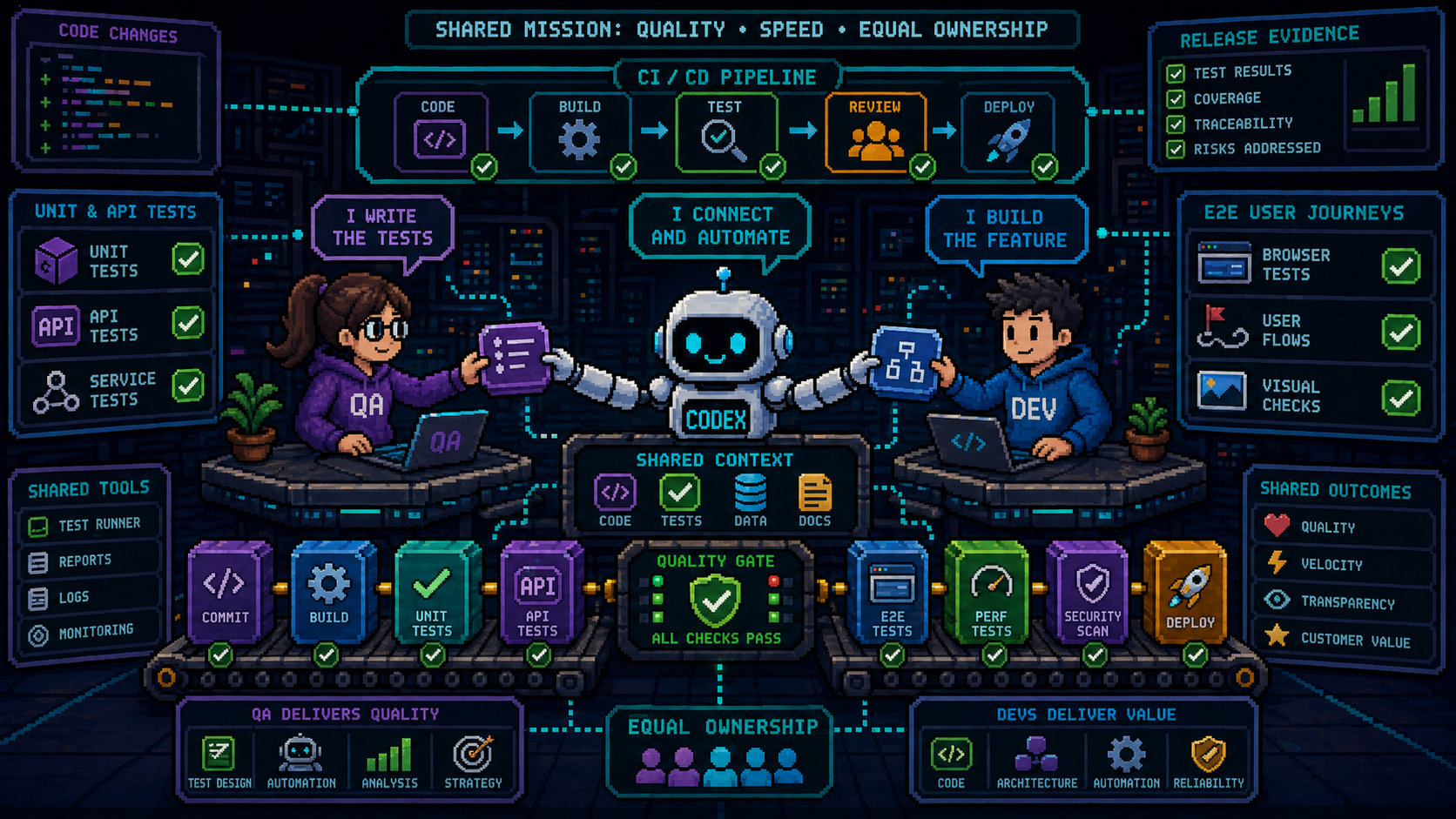
AI coding agents such as Codex/Claud change how software teams divide work. They make it easier for QA engineers to contribute closer to unit and integration testing, and they make it easier for developers to contribute more directly to end-to-end testing, exploratory support, and release evidence. This does not erase the difference between QA and development. It changes where the boundaries sit.
In the old model, developers often owned code and unit tests while QA owned test plans, manual validation, automation suites, and release confidence. In the new model, the tools lower the cost of crossing those boundaries. QA can ask an agent to inspect implementation details, draft unit tests, add API checks, and run focused commands. Developers can ask an agent to create end-to-end scenarios, review traces, summarize release risk, and improve testability.
The result should be equality on the field of software development: not because everyone does the same work, but because quality becomes a shared engineering responsibility. QA brings risk thinking, product judgment, exploratory skill, and user empathy. Developers bring implementation knowledge, architecture, code ownership, and testability.
The Old Boundary
Many organizations still work with an implicit boundary:
- Developers write production code.
- Developers write unit tests when time allows.
- QA validates the feature after implementation.
- QA writes or maintains end-to-end tests.
- Release quality is often discovered late.
- Automation failures are treated as QA-owned problems.
This model creates predictable friction. Developers may see QA feedback as late rework. QA may receive features with unclear requirements, weak testability, or missing lower-level coverage. End-to-end tests become overloaded because they are asked to catch defects that should have been caught earlier by unit, integration, API, or contract tests. Other issues, we all know what I’m talking about …
The New Paradigm
The new paradigm is not “QA becomes developers” or “developers become QA.” It is a more balanced model:
- QA can participate earlier in technical validation.
- Developers can participate deeper in product-quality validation.
- Both roles can use AI agents to move across the stack.
- Tests are placed where they give the fastest and strongest signal.
- Ownership is based on risk and knowledge.
QA Doing Unit Testing
QA engineers do not need to become full-time application developers to contribute to unit testing. They need enough technical access and agent support to express product risk at the right level.
QA can use AI Agent to:
- Read the implementation of a business rule.
- Identify missing edge cases.
- Draft unit tests for boundary values.
- Add parameterized tests.
- Verify error handling.
- Run the smallest relevant test command.
- Explain failing assertions.
Developers Doing End-to-End Testing
Developers also benefit from crossing the boundary. A developer who built a feature understands implementation details, but may not naturally think through all user journeys, permissions, devices, data states, and failure conditions.
Developers can use Codex to:
- Inspect existing Playwright, Cypress, Selenium, or Appium patterns.
- Draft end-to-end tests for the feature they changed.
- Use resilient selectors.
- Add meaningful user-visible assertions.
- Generate setup data through approved fixtures.
- Run the test locally.
- Diagnose trace failures.
- Keep the test scoped to the user behavior.
This helps developers feel ownership over more than code compilation. They own whether the user’s path still works.
Equality on the Field of Software Development
Equality does not mean identical responsibilities. It means both QA and developers participate as engineering partners with equal access to context, tools, and technical contribution paths.
In the AI-assisted model:
- QA should have access to the codebase, tests, CI artifacts, traces, and agent tooling.
- Developers should have access to quality criteria, risk models, test plans, and release evidence.
- Both should be able to propose test changes.
- Both should review quality impact.
- Both should understand why a test exists.
- Both should be accountable for defects that escape because quality work was deferred.
This breaks the unhealthy pattern where QA is treated as a gate at the end. QA becomes a partner in design, implementation, automation, and release readiness.
How Roles Change
QA Role Changes
QA becomes more technical, but not less human.
QA responsibilities shift toward:
- Risk modeling before implementation.
- Test strategy across the testing pyramid.
- Reviewing AI-generated tests.
- Adding or proposing unit and API tests for business rules.
- Designing data scenarios.
- Running exploratory sessions informed by code changes.
- Reviewing end-to-end tests for user value.
- Interpreting CI failures.
- Advising release confidence.
QA spends less time manually repeating scripted checks and more time deciding what evidence matters.
Developer Role Changes
Developers become more directly accountable for product quality beyond the unit-test layer.
Developer responsibilities shift toward:
- Designing features for testability.
- Adding lower-level tests as part of implementation.
- Creating or maintaining end-to-end coverage for owned flows.
- Reviewing AI-generated test code.
- Fixing flaky tests caused by product behavior or poor test hooks.
- Adding observability that helps QA and agents diagnose failures.
- Treating failing automation as product feedback, not QA noise.
Developers spend less time waiting for downstream feedback and more time validating behavior before handoff.
TPM and Product Role Changes
TPMs and product managers also change in this model.
They need to:
- Clarify ambiguous requirements early.
- Track quality risks across teams.
- Support time for test maintenance.
- Use AI-generated release summaries as evidence, not as final judgment.
- Ensure cross-team defects have clear owners.
AI agents can summarize risk, but humans still decide priorities and tradeoffs.
New Collaboration Patterns
Pairing With an Agent
QA and developers can pair through AI Agent on the same feature.
Workflow:
- Developer implements the feature.
- QA asks Agent to inspect the diff and propose risk areas.
- Developer asks Agent to add missing unit or API tests.
- QA asks Agent to draft end-to-end scenarios.
- Developer and QA review the generated tests together.
- Agent runs focused test commands and summarizes results.
- QA performs exploratory testing on the high-risk areas.
This creates a shared loop instead of a late handoff.
Shared Failure Triage
When CI fails, Agent can summarize the evidence and route the issue.
Example classifications:
- Product behavior changed: developer owner.
- Test data invalid: QA and test infrastructure owner.
- Requirement ambiguous: product and QA owner.
- Pipeline environment failure: DevOps or platform owner.
- Flaky user flow: developer and QA review together.
This turns blame into routing.
Risks in the New Model
The new model has risks if teams adopt the tooling without changing behavior.
Common failure modes:
- QA is expected to write code without time, training, or review support.
- Developers generate shallow end-to-end tests without QA review.
- AI-generated tests create false confidence.
- Teams add tests everywhere without a strategy.
- Test ownership becomes unclear.
- Managers use AI as a reason to reduce QA before quality culture has matured.
- The pipeline becomes green but user risk is still poorly understood.
AI Agents can speed up work, including the wrong work. Review and ownership matter more, not less.
Practical Operating Model
A strong cross-team model defines who owns each layer.
| Area | Primary owner | Shared with | Codex role |
|---|---|---|---|
| Unit tests for implementation details | Developers | QA for business-risk cases | Draft tests, find edge cases, run focused commands |
| Unit tests for domain rules | Developers and QA | Product for expected behavior | Convert risk cases into executable checks |
| API and contract tests | Developers | QA | Generate scenarios, verify schema and compatibility |
| End-to-end tests | QA and developers | Product for critical journeys | Draft tests, inspect patterns, diagnose traces |
| Exploratory testing | QA | Developers and product | Prepare charters, summarize changed areas |
| CI failure triage | QA, developers, platform | TPM for release blockers | Group failures and attach evidence |
| Release confidence | QA lead, product, TPM | Developers | Summarize evidence and unresolved risk |
This model avoids the question “who owns testing?” The answer becomes: everyone owns quality, but different people own different decisions.
Guardrails
Teams should set clear rules for AI-assisted cross-role testing:
- AI-generated tests require human review.
- QA can propose unit tests without needing to own production code.
- Developers should review maintainability of test code.
- QA should review test intent and risk coverage.
- No agent should remove assertions to make tests pass.
- No agent should skip critical tests without approval.
- Tests should be linked to risk, requirement, or user journey.
- End-to-end tests should not replace missing lower-level coverage.
- Exploratory testing remains part of the process.
These guardrails keep equality from turning into confusion.
What Success Looks Like
The new paradigm is working when:
- QA participates before code is complete.
- Developers add tests that reflect user behavior, not only implementation.
- End-to-end tests become fewer, stronger, and less brittle.
- Unit and API tests cover more business logic.
- CI failures are routed quickly.
- Test maintenance is not treated as QA-only cleanup.
- Release discussions use evidence instead of opinions.
- Both QA and developers understand the risk behind critical tests.
The best sign is cultural: quality conversations happen earlier and involve the right people.
Conclusion
AI Agents can change cross-team work by lowering the cost of moving across technical boundaries. QA can contribute to unit and API testing with stronger implementation context. Developers can contribute to end-to-end validation with stronger product context. TPMs and product owners can use better evidence to make release decisions.
But the goal is not to erase roles. The goal is to remove artificial walls. QA remains essential for risk, user judgment, exploratory thinking, and release confidence. Developers remain essential for implementation, architecture, and testability.
In this new paradigm, equality means shared access, shared responsibility, and shared evidence. We heard this many times so far, Personaly I will belive when I see it happend.