Creating Skills for Application Testing
Overview
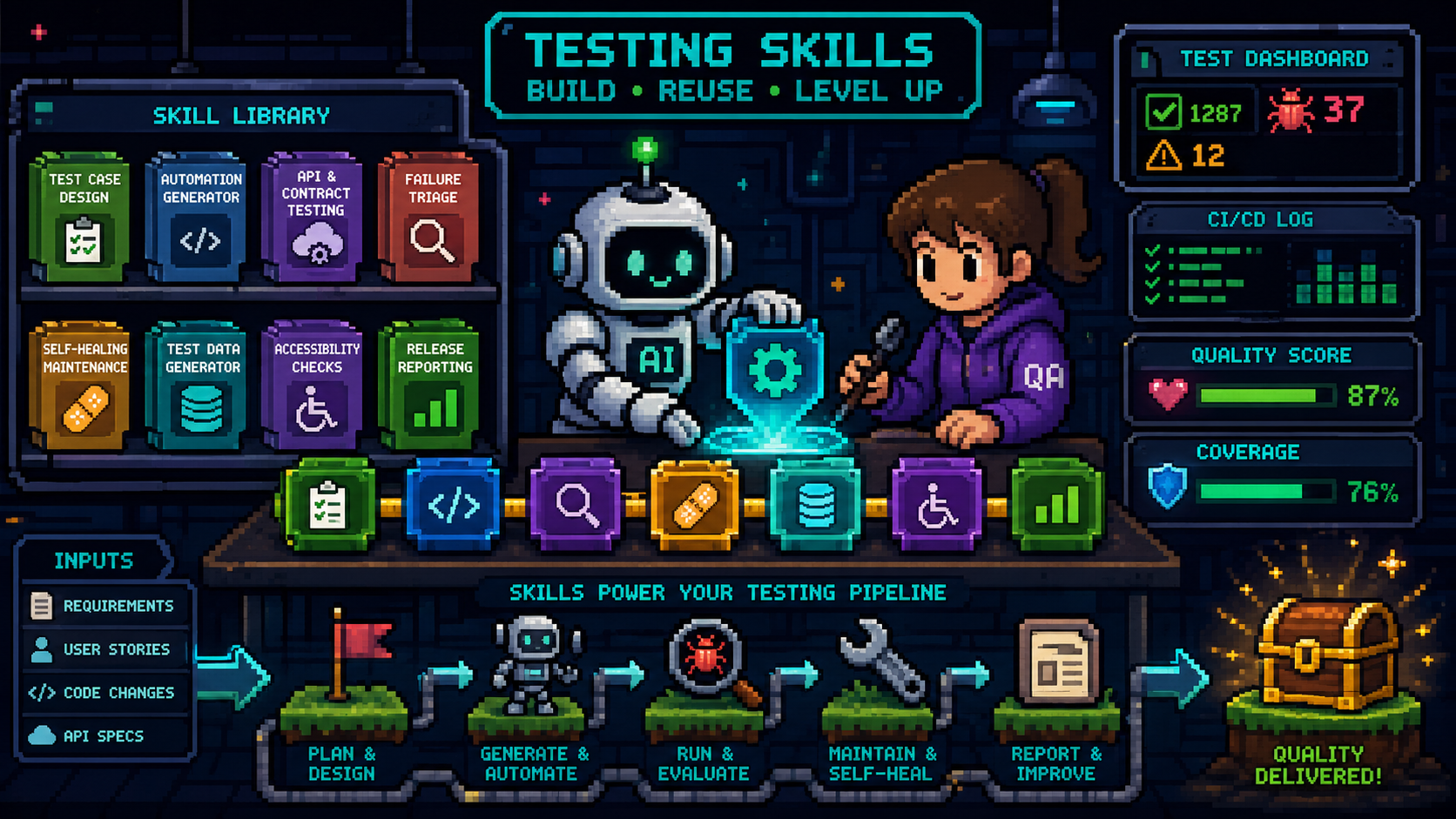
Skills are reusable instructions, workflows, and domain knowledge that help an AI assistant perform a specific kind of work consistently. For application testing, skills can turn a general AI assistant into a more reliable testing partner by teaching it how a team writes tests, triages failures, handles test data, reviews accessibility, reports defects, and works inside CI/CD.
A skill is not a replacement for testing strategy. It is a way to package repeatable testing judgment so the assistant starts from the team’s standards instead of guessing. A good testing skill can say: use Playwright roles before CSS selectors, never paste production data into prompts, attach trace links to bug reports, classify flaky tests separately from product bugs, and require QA review when assertions change.
The value is consistency. Without skills, every prompt depends on whoever is typing it. With skills, the team can standardize how AI helps across test design, automation, maintenance, reporting, and release support.
What a Skill Can Do
In application testing, a skill can provide:
- A repeatable workflow for a testing task.
- Rules for how to inspect requirements, code, logs, traces, screenshots, and test results.
- Templates for test cases, bug reports, release notes, and CI summaries.
- Framework-specific guidance for Playwright, Cypress, Selenium, Appium, pytest, Jest, or API tests.
- Data handling rules for privacy, security, and synthetic test data.
- Review checklists for generated tests.
- Escalation rules for QA, developers, product owners, and TPMs.
- Examples of accepted output.
The assistant still needs context from the repo, product, or ticket. The skill gives it a disciplined way to use that context.
Why Skills Matter for QA
AI can generate a lot of test-related output quickly, but fast output is not automatically useful. QA teams need repeatable quality, clear risk coverage, and evidence that generated work matches the product.
Possible Use Cases
Automated Test Generation
A test generation skill can tell the assistant how to add tests in the team’s existing style.
It can include rules such as:
- Inspect nearby tests before writing a new one.
- Reuse existing fixtures and page objects.
- Prefer user-visible locators.
- Keep one behavior per test.
- Avoid broad sleeps and arbitrary retries.
- Run the smallest relevant test command.
- Report the changed files and test result.
This is especially useful in repositories with established automation patterns.
Test Review
A test review skill can help QA or developers review AI-generated or human-written tests.
It can check:
- Is the assertion meaningful?
- Does the test verify behavior or implementation detail?
- Is the setup isolated?
- Is the locator stable?
- Could the test be flaky?
- Does the test cover the intended risk?
- Are cleanup and data handling safe?
This skill is valuable because generated tests often look plausible even when they do not protect a real business outcome.
Failure Triage
A failure triage skill can summarize CI failures and group them by likely root cause.
It can inspect:
- Stack traces.
- Browser screenshots.
- API responses.
- Console logs.
- Recent commits.
- Known flaky-test history.
Useful output should classify failures as product bug, test bug, environment issue, data issue, flaky timing, dependency outage, or unknown. It should also cite the evidence behind the classification.
Self-Healing Test Maintenance
A self-healing skill can guide the assistant through safe maintenance work.
It can propose:
- Locator updates.
- Fixture repairs.
- Better selectors.
- Cleanup for stale test data.
- Flaky-test investigation steps.
- Pull requests for low-risk maintenance.
The skill should also define hard limits: do not remove assertions, do not skip critical tests, do not change app behavior to make a test pass, and require QA approval when test intent changes.
Accessibility Testing
An accessibility skill can help with both automated and manual accessibility checks.
It can guide the assistant to:
- Check keyboard navigation.
- Review labels and accessible names.
- Look for missing alt text.
- Inspect color contrast concerns.
- Confirm focus order.
- Recommend screen-reader test areas.
- Add accessibility assertions where the framework supports them.
AI can assist with accessibility coverage, but it cannot replace human testing with assistive technologies.
API and Contract Testing
An API testing skill can help produce request matrices, schema checks, contract tests, and negative cases.
It can define:
- Required status codes.
- Required headers.
- Auth and permission cases.
- Schema validation rules.
- Consumer contract expectations.
- Backward compatibility checks.
This is useful when services change frequently and teams need faster feedback before UI tests fail.
Release Reporting
A release reporting skill can summarize quality evidence for product managers, TPMs, QA leads, and engineering managers.
It can produce:
- Test pass and fail summaries.
- Critical journey status.
- Known risks.
- Open defects.
- Flaky-test impact.
- Blockers and owners.
- Confidence level by feature.
The skill should require links to raw evidence such as CI runs, test reports, bug tickets, logs, traces, and dashboards.
How to Design a Good Testing Skill
A useful testing skill should be narrow, concrete, and opinionated. It should not say “write good tests.” It should define what good tests mean for this team.
Each skill should include:
- Purpose: what task it handles.
- Inputs: what the assistant needs before starting.
- Workflow: the steps to follow.
- Rules: what must always or never happen.
- Output format: what the final answer should include.
- Review gates: when QA, developer, product, or TPM approval is required.
- Examples: accepted test cases, bug reports, or summaries.
The skill should be short enough to follow, but specific enough to prevent generic output.
Example Skill Ideas
Teams can create separate skills for different testing jobs:
| Skill | Purpose | Human owner |
|---|---|---|
| Story to Test Matrix | Convert requirements into reviewed test scenarios | QA |
| Playwright Test Writer | Add focused Playwright tests using local patterns | QA / developer |
| CI Failure Triage | Summarize and classify failed pipeline runs | QA / DevOps |
| Flaky Test Investigator | Diagnose unstable tests and propose fixes | QA |
| Accessibility Review | Check UI changes against accessibility expectations | QA / accessibility specialist |
| API Contract Test Builder | Draft API and consumer contract checks | developer / QA |
| Release Risk Summary | Produce quality status for release decisions | TPM / QA lead |
| Self-Healing Review | Evaluate proposed test maintenance changes | QA |
Implementation Roadmap
Start small:
- Create one skill for test case design from user stories.
- Add one skill for CI failure summaries.
- Add one skill for test automation in the team’s main framework.
- Review generated output for two or three sprints.
- Convert repeated QA feedback into skill rules.
- Add more specialized skills only after the first ones prove useful.
The best skills are built from real review comments. If QA repeatedly tells the assistant to avoid CSS selectors, cite trace evidence, or clarify expected behavior, those rules belong in a skill.
Conclusion
Skills give teams a practical way to make AI-assisted testing more consistent. They package testing workflows, rules, examples, and review gates so the assistant works closer to the team’s standards.
For application testing, skills can help design tests, generate automation, review quality, triage failures, maintain suites, generate synthetic data, and summarize release risk. The strongest use is not autonomous testing. The strongest use is repeatable, reviewable testing support that keeps QA judgment at the center.